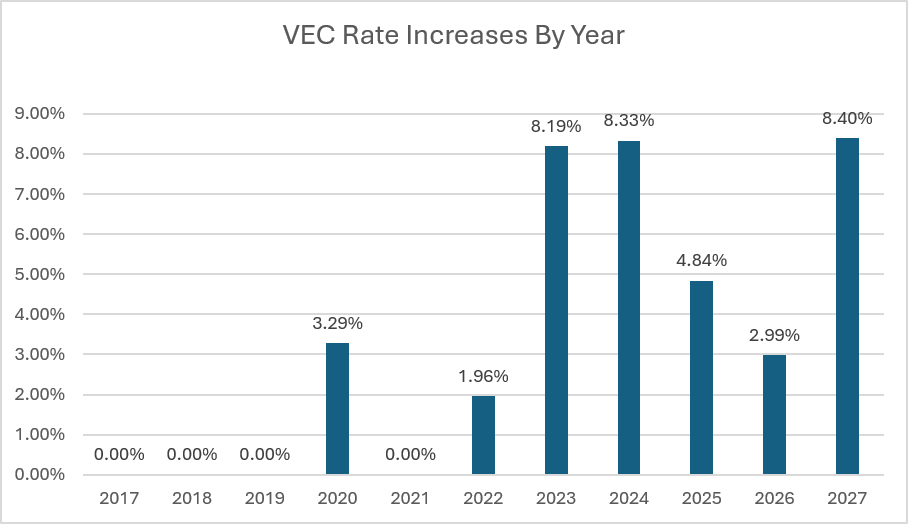
We recognize that rate increases put pressure on household and business budgets. Before filing, we scrutinized our spending and made budget reductions while preserving essential service and reliability work.
As always, affordability guided our budget review before filing. We made budget reductions that lowered the estimated proposed increase during preparation of the request, though we were careful to preserve our ability to support the essential work of maintaining safe and reliable service. We also took steps to manage electricity and transmission costs, described below.
Reducing peak power use to save on transmission costs
We are continually seeking ways to contain costs and be smart stewards for our members.
One important strategy is reducing the amount of electricity VEC uses during the highest-demand hours on the New England electric grid. A significant portion of our transmission costs is based on how much electricity our members are using during the single hour when New England's demand is highest, which makes avoiding usage during that peak hour valuable.
VEC already uses two utility-scale batteries to reduce our demand during peak periods. Members help through our voluntary Beat the Peak program, and by allowing us to manage their home batteries or electric vehicle chargers during peak times. These programs allow us to use stored energy or reduce demand when electricity and transmission costs are particularly high.
In 2027, a new 5MW utility-scale battery in South Hero will be added to our demand reduction resources. As transmission costs continue to rise across New England, investments like this can help us mitigate those anticipated cost increases.
Savings in everyday work
Sometimes saving money is about finding a smarter way to do something we have done for decades. Every year, for example, we inspect a portion of the thousands of wood poles across our system. Traditionally, when a pole nears the end of its useful life, we replace it. We have recently begun using a product that allows us to reinforce some poles instead, safely extending their lives by up to 10 years and delaying the cost of replacement.
In 2027, VEC plans to pilot an internal drone program. During storms, drones could help us assess damage in remote areas before employees enter difficult or potentially hazardous terrain. In Winter Storm Elliott one road required days of tree clearing before we could get access to the damaged equipment, only to then also find several broken poles. Drones could help us speed up the restoration process and reduce inspection time for other tasks, too, such as routine vegetation management.
These small changes are one of the ways we think about affordability: keep looking, keep learning, and keep seeking efficiencies and savings.
Leaning in to grant dollars
We are also aggressively pursuing grants so that our members do not have to bear the full cost of necessary investments. In recent years, grants have provided extensive value to VEC through strengthening lines, improving storm resiliency, and modernizing technology.
For 2027 and beyond, we have several anticipated grants including $460,000 for storm response and Emerald Ash Borer mitigation. We have three construction projects which benefit from $1.3 million in FEMA hazard mitigation grants. We are also finalizing $4.45 million in federal funding for our meter upgrade project to support that project over the next three years.