Net metering allows VEC members to connect eligible small-scale renewable energy systems to the electric grid and receive credits on their electric bills for power the systems generate. Solar is the most common type, but wind, hydro, and methane systems may also qualify.
Information on this page primarily applies to applications
submitted on or after January 1, 2017.
If your system was installed before 2017, see
Systems Installed Before 2017
below or call
1-800-832-2667.
Getting started
How to Apply for Net Metering
Follow these five steps to move from planning to producing your own renewable energy.
1
Choose an Installer
Research your options and consider getting more than one quote. VEC does not recommend specific installers.
2
Submit Your Application
Your installer will typically help file the required net-metering registration or application.
3
Receive Approval
Complete applicable VEC interconnection and Public Utility Commission approval steps before installation.
4
Install Your System
Once authorized, your installer completes installation and requests VEC production metering.
5
Start Generating
Once the system is online, eligible net-metering credits will appear on your electric bill.
Application Requirements by System Size
Public Utility Commission (PUC) Rule 5.100 and Rule 5.500 govern the certificate of public good (CPG) and interconnection processes. Updated processes began March 1, 2024.
VVEC reviews and must issue interconnection approval letter to applicant stating any requirements or no requirements for interconnection by the 31st day following a completed application unless the project fails the preliminary screening criteria and requires further analysis as laid out within the rule.
Applicant files for CPG on ePUC using appropriate Net-Metering Registration/Application and attaches VEC approval letter as part of filing.
VEC reviews and must issue interconnection approval letter to applicant stating any requirements for interconnection by the 31st day following a completed application unless the project fails the preliminary screening criteria and requires further analysis as laid out within the rule.
Applicant files for CPG on ePUC using appropriate Net-Metering Registration/Application and attaches VEC approval letter as part of filing.
Optional Pre-Application Report
You may request a pre-application report to help evaluate a proposed project. The fee is $300.
After your system receives interconnection approval, you must obtain a Certificate of Public Good (CPG) through the Vermont Public Utility Commission's ePUC system. Whether you complete a registration or an application depends on the size and type of your renewable energy system.
A ground-mounted solar system
larger than 15 kW and up to 500 kW
Another eligible renewable energy technology
(other than solar photovoltaic)
up to 500 kW
Net-metering information
Rates, Credits, Fees and More
Explore compensation rates, renewable energy certificates, how credits are applied, and additional costs.
$Compensation & Bill Credits
$0.2071 / kWh
For excess energy sent to the grid, VEC's current published blended residential rate is $0.2071 per kilowatt-hour (kWh). Applicable adjustments may affect the credit value for a system.
The appropriate credit appears on your monthly electric bill. The customer charge and energy efficiency charge are non-bypassable: net-metering credits cannot be used to pay these charges.
Unused net-metering credits stay on the account for up to 12 months after they are generated, then expire.
Siting & REC Charges
For applications dated August 1, 2026 or later, VEC's published siting charges are:
Systems 150 kW or smaller$0.05/kWh
Over 150 kW on a preferred site$0.07/kWh
Over 150 kW not on a preferred site$0.08/kWh
Retaining RECs: $0.04/kWh produced for the life of the system. See the explanation below.
One-Time Fees
There is a one-time account set-up charge. That charge depends on how many accounts are involved, and they are as follows:
Single-member systems and groups with up to 3 accounts$33
Groups with 4–15 accounts$66
Groups with more than 15 accounts$132
Production/Generation meter$160.80
Meter installation$80
Both meter charges are one-time costs. Some projects may also require electrical service upgrades; ask VEC about site-specific interconnection costs.
Renewable Energy Certificates (RECs)How REC ownership affects net-metering credits and what happens when RECs transfer to VEC.
Renewable Energy Certificates (RECs) represent the environmental attributes of renewable generation. Applicants must choose whether to retain ownership of these attributes. The charge for retaining RECs is $0.04/kWh for the energy the system produces.
Most applicants since 2017 have chosen not to retain their RECs to receive a higher credit. RECs transferred to VEC remain in Vermont and help VEC comply with the state's Renewable Energy Standard. Under Vermont law, utilities cannot resell net-metering RECs.
Transferring Excess CreditsLearn how to allocate future net-metering credits to another eligible VEC account.
Members may establish a group to allocate credits to another eligible account on VEC's system. Allocations must be set prospectively, when credits are generated. Credits cannot be transferred just before they expire.
Systems Installed Before 2017Review the compensation rules for systems installed before January 1, 2017.
Systems installed before 2017 are not subject to the 2017 changes during the first 10 years after commissioning. After that, they transition to the statewide blended rate for excess generation and become responsible for applicable non-bypassable charges.
For information specific to your system, call 1-800-832-2667.
Your bill, explained
Understanding Your Net-Metering Bill
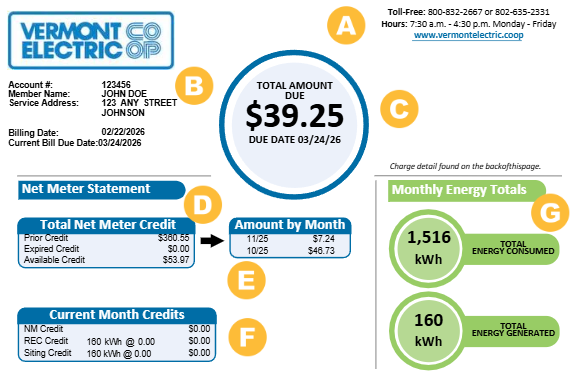
Not sure what the numbers on your net-metering bill mean? Our interactive bill explains how energy use, system generation, charges, and net-metering credits appear on your monthly statement.
Select the letters on the example bill to learn what each item means.
Find answers to common questions, access forms, or contact VEC for assistance.
?
Common Questions
Is there a limit on the number of net-metering systems?
There is no program-wide cap on the number of net-metering systems that can come online. Individual projects must still satisfy PUC requirements, including required approvals.
Does VEC recommend solar installers?
No. VEC recommends researching installers, asking neighbors or others in your community for recommendations, and requesting more than one quote to compare costs.
Can net-metering credits pay my entire bill?
Not necessarily. Customer and energy efficiency charges are non-bypassable and cannot be paid using net-metering credits. Credits also expire 12 months after they are generated if unused.
Can I allocate credits to another account?
Yes, through an eligible net-metering group. Allocations must be arranged for future credits; use the group request form.